Oil and Gas Technologies
There is an ongoing need for innovative technologies, services, and systems that drive significant advances in performance, safety, and reliability in the oil and gas industry.
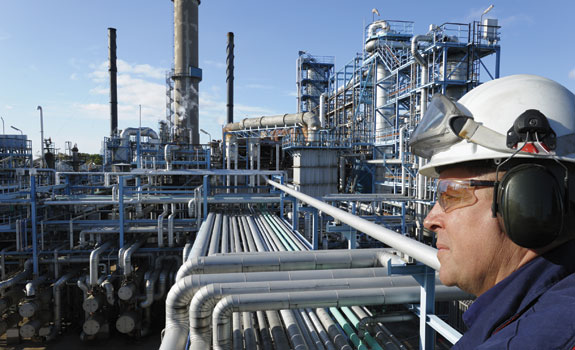
▲ By 2050, total fuel demand in all transport modes is projected to increase by 30% to 82%, driven mainly by the need for gasoline, diesel, fuel oil, and jet fuel for trucks, buses, trains, ships, and airplanes.
(World Energy Council)Customers turn to Curtiss-Wright for one-of-a-kind solutions in the form of specialized valves, pumps, controls, and process systems for refineries in established and emerging markets.
Our advanced technologies create an economic path to improve and upgrade entire systems. Within the delayed coking unit at refineries, for example, we produce complete systems including top and bottom unheading valves, center feed injection nozzles, isolation valves, coke cutting and boring tools, fully integrated hydraulics and controls systems, and large diameter coke-drums.
By offering complete systems rather than simply individual products, Curtiss-Wright provides profound value to its customers and expands growth opportunities for its core business. Within delayed coking, the "total system" approach can provide individual products up to and including full site engineering services, integrated hydraulics and controls systems, safety systems and services, and site installation.
The "total system" scope of products and services offered by Curtiss-Wright provides refiners reduced project overhead cost and improved safety, reliability, and maintenance. This approach offers the convenience of dealing with a single supplier for multiple, integrated, highly engineered products, rather than many individual, uncoordinated vendors supplying independent products.
Curtiss-Wright also has developed and acquired a broad range of technology and manufacturing capacity to upgrade existing facilities to improve worker safety, to require fewer and shorter maintenance shutdowns, and to enhance efficiency in plant processes. Our electro-hydraulic controlled slide valves and actuator systems not only enable efficient, reliable operations, but they also extend the operating cycle of these units in refineries.
Replacement and upgrades of valves used in the critical stages of refining and processing operations are custom designed and manufactured, and benefit from improvements in metallurgy and technology unavailable when the plant was originally built. No two valves are alike. Each valve is designed to a specific temperature, pressure, flow, and diameter, and for a specific process in a specific geographic environment.
Curtiss-Wright's technological advances substantially reduce wear and erosion, and leverage digital technology for enhanced operation and diagnostics. Our iPRSM® system serves as a one-source solution for the management of pressure relief systems by enabling automated verification, analysis, documentation, and full compliance with regulatory codes and industry standards over the life cycle of processing facilities.
Moreover, Curtiss-Wright's patented large valve designs permit removal of operating components as unitized sub-assemblies, eliminating the need to remove the entire valve from the system, thus avoiding a production line shutdown for an extended period. Systems that previously required extensive maintenance every two years can now operate up to twice as long before scheduled maintenance — an attractive value proposition in an industry that traditionally estimates $1 million in lost revenue for each day of shutdown.